


Protecting Your Attention in a World That's Constantly Trying to Steal It
"In a world where everything is competing for your attention, protecting it may be one of the most important leadership skills you'll ever develop."
It feels like everything wants our attention.
Our phones. Our inboxes. Slack. Social media. Calendar invites. Team members. Clients. Our spouses. Our kids.
Some days it feels like standing in the middle of a park with a single piece of bread. At first, one pigeon shows up. Then five. Then twenty. Before you know it, you're surrounded by hundreds of pigeons all fighting over the same piece.
That's what leadership feels like today.
Everyone wants a piece of your attention.
The hard part is that none of those things are bad. Your team needs you. Your family needs you. Your clients need you. Your community needs you. Life doesn't slow down because your calendar is full.
Adulting is hard.
Running a business is hard. Being a great spouse is hard. Raising kids is hard. Trying to stay healthy is hard. Giving back to your community is hard. Somewhere in the middle of all that, we're still expected to think strategically, solve problems creatively, and lead people well.
That's a lot.
About a year ago, I shared a blog about hiring my first Lifestyle Manager. At the time, I knew I needed support, but I really had no idea how much the relationship would evolve.
A year later, life looks a little different. My role at Zipdev has evolved. I've had the privilege of stepping into the presidency of EO San Diego. My boys are busier than ever. Somehow, my calendar found even more ways to fill itself up.
And through all of it, one thing has become crystal clear.
The relationship compounded.
Some mornings she's helping me prioritize client emails. Later that afternoon she's researching an unforgettable forum retreat. Somewhere in between she's reminding me about a school event for one of my boys, coordinating travel, and making sure I actually finish the projects I keep pushing to tomorrow.
That's why I don't call her an Executive Assistant.
She's a Lifestyle Manager.
Over the past year, I realized something that surprised me.
Karla doesn't just help me manage my calendar.
She helps me protect my attention.
And protecting my attention gives me something I didn't expect.
A blank canvas to think creatively.
The first place I noticed the difference was my inbox.
Before Karla, I'd start every morning feeling behind. Emails needed responses. Team members were waiting on me. Requests kept piling up, and before I knew it, my day had become one long reaction to everyone else's priorities.
Today, I walk into clarity instead of chaos. Emails have already been routed to the right people. The important items are waiting for me, and just as importantly, I'm no longer the bottleneck.
That alone changed the way I lead.
Leadership isn't just about making good decisions. It's about removing friction for the people around you. When information moves faster through the organization, my team keeps moving instead of waiting for me to hit "forward."
The second breakthrough came from something we honestly stumbled into.
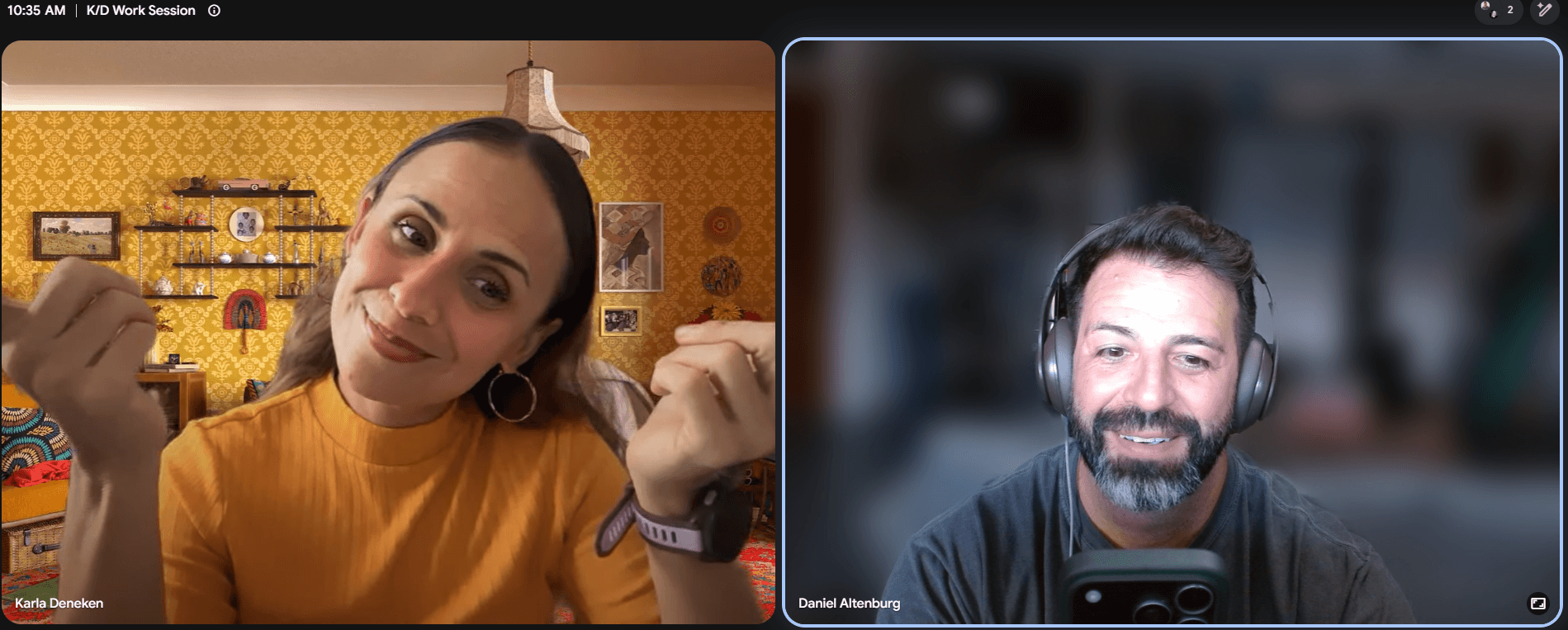
Three times a week, Karla and I block off at least 90 minutes on Google Meet. Cameras on. My screen is shared. She has a running Google Doc with every project I'm juggling, from sales and marketing to EO responsibilities, client relationships, and personal projects.
Then we work.
She'll laugh and say, "Jefe... put your phone down."
She knows exactly when my attention starts drifting, and honestly, she's usually right.
Those sessions have become one of the most valuable parts of my week. Not because we magically finish everything. We don't. Leadership doesn't work that way. They matter because they create protected time in a world that's constantly trying to interrupt us.
No meetings. No interruptions. No bouncing between ten different priorities.
Just focused execution.
The to-do list never disappears, but it stays manageable. And when my to-do list stays manageable, my mind does too. That's when I get a blank canvas to think creatively. That's when I get to brainstorm new marketing ideas, think through sales strategies, strengthen client relationships, improve our culture, and solve the kinds of problems that actually move Zipdev forward.
That's the work I love.
Another moment that really drove this home happened while planning a retreat for my EO forum.
I had a very clear vision. I wanted us rafting down the Colorado River, sleeping on the riverbank, disconnecting from technology, strengthening our relationships, and creating memories we'd still be talking about years later.
I could have spent days researching rafting companies, comparing pricing, scheduling calls, and reading reviews.
Instead, I sat down with Karla and painted the vision.
I didn't tell her which company to choose.
I told her how I wanted everyone to feel.
She researched the options, vetted multiple outfitters, and came back with her top two recommendations. I made the decision in minutes instead of days. That gave me the freedom to focus on what only I could do: designing the conversations, exercises, and experiences that ultimately made it one of the best forum retreats we've ever had.
One of the biggest lessons I've learned is that none of this happened overnight. Like any great relationship, this one evolved.
At the beginning, we checked in every day. We gave each other constant feedback. We learned each other's rhythms.
She wasn't just learning my calendar.
She was learning me.
She learned how I think, how I prioritize, when I need someone to push me, and when I need someone to protect my time.
One week I'm saying, "Karla, load me up with sales meetings."
Two weeks later I'm asking, "Why in the world is my calendar so full?"
As founders and business owners, we're not always the easiest people to keep up with.
That's why this relationship works.
We've learned how to adapt together.
I'd be lying if I said AI hasn't changed the way I work. I use it every day, and it's become one of the most valuable tools in my toolkit. It helps me move faster, organize ideas, and eliminate busy work.
AI helps me move faster.
Relationships help me move forward.
I realize not everyone is in a position to hire a Lifestyle Manager, and that's okay. This article isn't really about hiring one specific role. It's about recognizing when your attention has become one of your most valuable resources and intentionally finding ways to protect it.
For me, that looked like hiring Karla.
For someone else, it might look completely different.
Every day, something is trying to steal your attention. An email. A notification. A meeting. A text. A new idea. A problem that suddenly feels urgent.
None of that is going away.
The question isn't whether the world will keep asking for your attention.
It will.
The real question is whether you'll intentionally protect it.
Because protecting your attention isn't just about eliminating distractions. It's about creating enough space to do your best thinking.
Over the past year, that's become one of the biggest leadership lessons I've learned.
Ironically, it wasn't another piece of technology that taught me that.
It was a relationship.
Best,
Daniel